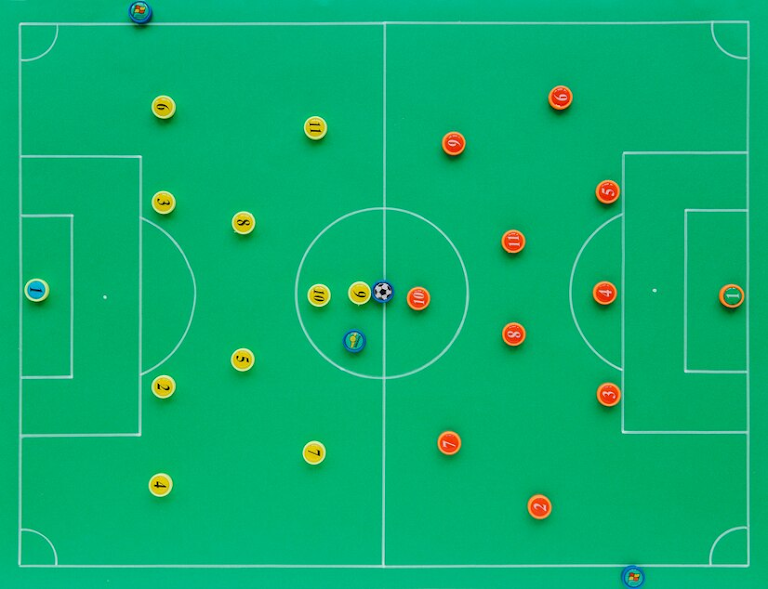
The diamond formation is one of the most common tactics used in soccer, with a special emphasis on the center. It entails forming a diamond formation that would enable players to spread wide and also cover defense and attacking structures. This array also forms a balance and has a dynamic nature. It is very useful when used correctly. Said formation structure, combined with its benefits, is one of the reasons that many teams and coaches prefer it.
Organization of the Diamond Formation
The diamond formation in soccer has one defender as the defensive midfielder, two midfielders as the central midfielders, and one as the attacking midfielder. This order forms a diamond pattern on the pitch. The defensive midfielder is a stopper who should cover the defenders, while the central midfielder is one who dictates the pace of the game and looks for good passes to make. The attacking midfielder is the playmaker, and sometimes both a midfielder and a forward.
This order is quite similar to other sports strategies; for example, in cricket betting, structures and positioning can greatly affect the result. The diamond formation provides clear roles and responsibilities for each player, and this makes the performance of the team efficient.

The Diamond Formation Has Several Advantages
Here are several key advantages:
- Central Control: He holds the central part of the field, which gives him more control over the rate of the match.
- Support and Balance: Supports defense and attack almost equally; therefore, there is balance.
- Flexibility: Can easily fit into the attacking or the defending side of the game.
These strengths make the diamond formation versatile and potent, especially for those teams that seek to dominate the center and those teams that seek to have a quick transition from the defense line to the attacking line.
Tactical Positions in the Diamond Formation
All the players in the midfield have responsibilities that need to be fulfilled for the team to run well in the diamond formation. It is a good balance between defense and offense, and all the players are aware of what they are supposed to do. More information about this type of team order can be found on the portal: https://www.facebook.com/groups/381879567540316. This formation is based on cooperation. Let’s look at the two most crucial roles: defensive and attacking central midfielders.
Defensive Midfielder’s Role
The defensive midfielder is an important figure in diamond formation. This player’s main role for the team is to shield the defense side from any attacks by the rivaling team. They are stationed at the lower end of the diamond formation; they hug the defenders, making it difficult for the other team to penetrate.
While the major role of the player is to defend the team, the defensive midfielder also plays a role in beginning the attack by passing the ball to other players. They should free their minds and think critically and quickly because one bad call will cost the team a goal. This position is more or less a defensive one in that it involves maintaining a defensive line while at the same time seeking an opportunity to move forward.
Attacking Midfielder’s Role
At the top of the diamond, the attacking midfielder is the playmaker of the side and the team overall. Their primary function is to make scoring potential for the forwards, and occasionally, they shoot themselves. This player must be able to see and think very fast to make the right decisions in the course of the game.
Thus, apart from the attacking role of this player, they also have to provide support in the defense. They have to put pressure on the opponents’ defenders and attempt to regain possession of the ball as far from their own goal as possible. For this reason, the attacking midfielder plays an important role in the diamond formation because he links the midfield and the attack at the same time, as he is also involved in defending.
Flexibility in Transition Play
It is also characterized by flexibility, especially when changing from the attacking formation to the defending one. This formation enables the teams to regain balance and possession most of the time so that they can control the matches. Key advantages include:
- Smooth Transitions: Players can easily switch from a defensive mode to an attacking mode, therefore putting the opponent under pressure.
- Strong Midfield Presence: The formation makes it possible for the team to be compact, especially in the middle of the pitch.
- Creative Options: In this formation, the players are well-positioned to create many attacking possibilities. Thus, the movement of the team is very difficult to anticipate by the opponent.
This flexibility is rather important to make changes at a high speed in a match, and it provides teams with an advantage in critical moments.

Possible Disadvantages of the Formation
Although the diamond formation is a perfect structure to implement, it has some disadvantages. The problem is that it can make the team vulnerable on the wings. As it will be seen, the formation lays much emphasis in the middle of the field, and this means that it is often narrow, thus making it easy for the rival team to penetrate from the flanks.
The third weakness is its high requirement for the players, mainly in terms of their physical strength and endurance, as well as their ability to maneuver. Midfielders require a lot of work and constantly ought to keep an eye on their teammates and opponents so as not to have gaps in the formation. In the event that a player is out of position, the other team can launch a quick counterattack.
Final Words
Diamond formation is a great tactic in football as it provides much discipline and versatility. However, it has to be done carefully, and the people who work on it have to be skilled to prevent the hazards of this strategy. If applied rightly, it may well be the factor that defines how well a team controls the central ground and triumphs in various games.